Mary Oliver Love Poems
Mary Oliver Love Poems: When Nature Becomes the Language of the Heart
There are poets who write about love, and then there are poets who find love — in unexpected places, in the unhurried world, in the things most of us walk past without stopping.
Mary Oliver was the second kind.
Her love poems don’t announce themselves. They arrive quietly, through a field of grass or a particular quality of morning light, and by the time you realize what has happened, something in you has shifted. You’ve been moved without quite knowing when the moving began.
That’s the particular gift of her work — and why readers return to it not just once, but at different points in their lives, finding something new each time.
Who Was Mary Oliver
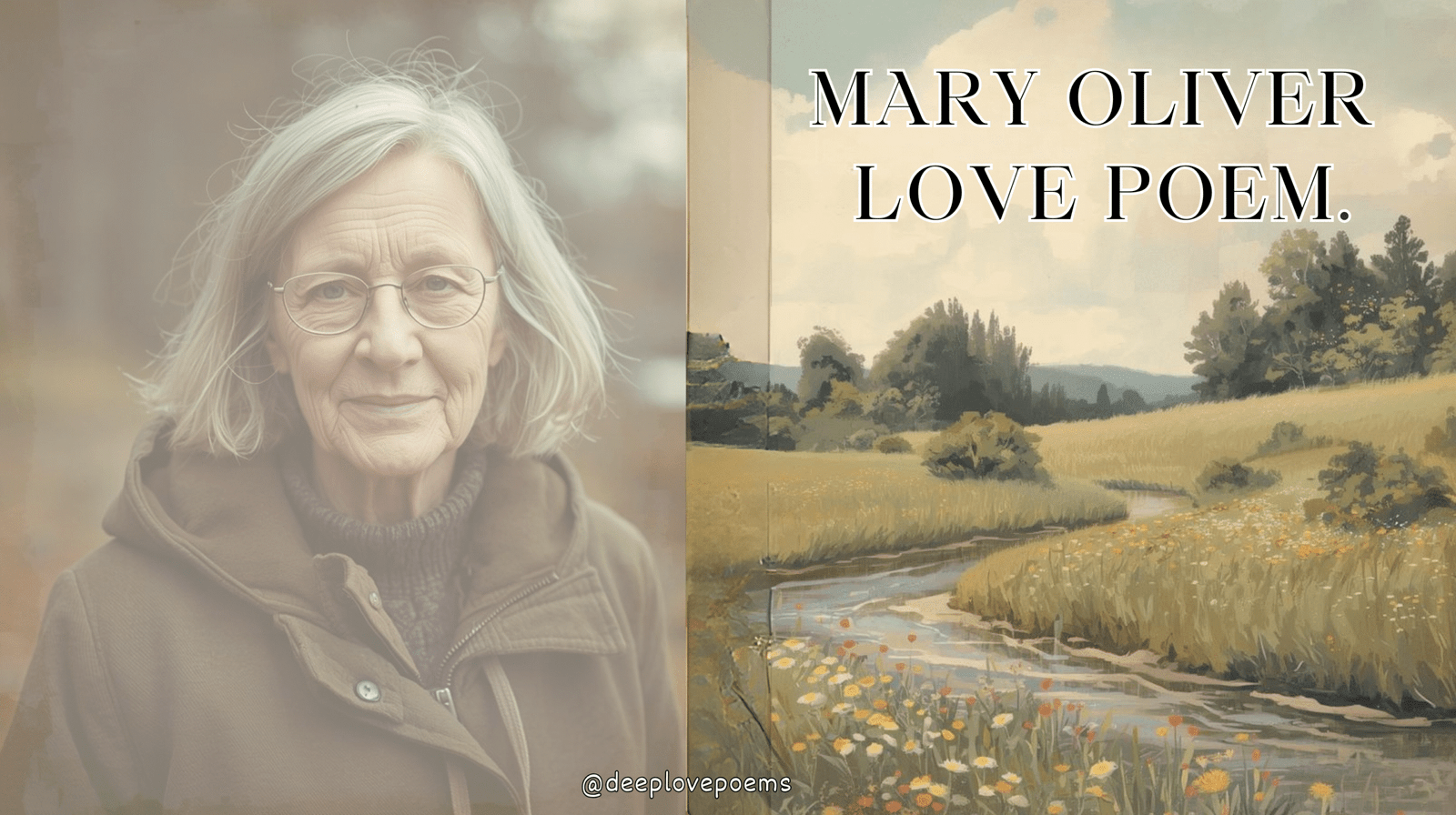
Mary Oliver (1935–2019) spent most of her life in close attention to the natural world — first in Ohio, then for many years in Provincetown, Massachusetts, where she walked the same paths daily and wrote poems that made those walks matter.
She won the Pulitzer Prize and the National Book Award, but what made her beloved was simpler than either: she wrote poems that people actually wanted to read. Poems that felt like conversations. Poems that asked difficult questions gently, without demanding that you answer them in any particular way.
Her work is accessible without being shallow. Clear without being simple. And when it touches love — which it does, in various forms, throughout her entire body of work — it touches it honestly.
How She Understood Love
Oliver’s love poetry is not confined to romantic love, though it holds that too. What she explored more broadly was the experience of connection — to another person, to the world, to the self.
For Oliver, these were not separate things. The way you love a person and the way you notice a grasshopper balancing on a stem of grass — both require the same quality of attention. Both ask you to be present, unhurried, genuinely interested in something outside yourself.
This is why her most quoted lines feel so universally true. When she writes about allowing yourself to love what you love — to stop performing and start actually feeling — she’s talking about all of it at once: romantic love, self-acceptance, the simple act of paying attention to your own life.
The Poems Themselves
Wild Geese is perhaps her most beloved poem, and the reason is easy to understand. It begins not with a celebration but with a kind of permission — you do not have to be good, she says. You do not have to walk on your knees for a hundred miles through the desert repenting.
The poem offers:
You only have to let the soft animal of your body love what it loves.
That single image — the body as a soft animal with its own instincts and needs — reframes the conversation about love entirely. It says: stop performing. Stop trying to love correctly. Your body knows what it loves. Trust it.
The poem ends with belonging — the world calling out to you regardless of your failings, offering you a place in the family of things. It has been used in therapy, in grief groups, at funerals, at weddings. It works in all of those contexts because it speaks to something that exists before the specific occasion, something foundational about what it means to be a creature capable of love.
The Sun works differently. It is a poem of sustained praise — for the sun specifically, but praise that overflows into everything the sun touches, which is everything. Reading it feels like being in the presence of someone who has never lost the capacity for wonder, which is both beautiful and quietly instructive.
The love in this poem is not directed at a person. It’s directed at existence itself. Oliver was interested in this kind of love — the love that doesn’t need an object, that simply opens outward. She believed, and her poems make this case quietly but consistently, that this openness was not just pleasant but necessary. That the people who could love a field or a sunrise were also capable of loving other people more honestly.
To Begin With, The Sweet Grass explores love as something grounding — not dramatic or consuming, but steadying. It suggests that love thrives not in intensity but in simplicity, in the willingness to be honest about what you feel rather than performing what you think love should look like.
Oliver writes about love the way she writes about grass: carefully, with close attention, without sentimentality. The result is something that feels more true than most poems that try harder.
Nature as a Blueprint
One of the reasons Oliver’s love poetry endures is that she found in the natural world a vocabulary that escaped the clichés of traditional love poetry.
Instead of reaching for roses and sunsets (which she didn’t dismiss, but didn’t rely on), she reached for the specific and the overlooked — a grasshopper, a black bear, a heron standing in still water. These images work because they carry no prior emotional freight. They arrive fresh, and they can hold whatever emotion Oliver brings to them.
The effect is that her love poems feel discovered rather than constructed. As if she found love in the grass and simply reported back.
Writing Love Poems in Her Manner
If her work moves you and you want to try writing in this spirit, the practice is straightforward — though not easy.
Go outside. Or look out a window. Find one thing — not a beautiful thing necessarily, just a specific, real thing. A bird on a wire. The light on a wall at a particular time of day. The way rain sounds on a particular surface.
Sit with it. Don’t rush to make it mean something. Just look.
Then ask: what does this remind me of? What feeling does it carry? Where in my life have I felt this quality before?
Oliver often zooms in on a single image until it opens up into something larger. The grasshopper becomes a meditation on mortality. The sun becomes a meditation on gratitude. The wild geese become permission to exist as you actually are.
That movement — from the particular outward to the universal — is her method. And it works because it begins with something real.
Why These Poems Last
Mary Oliver died in 2019, but her readership has continued to grow since then. New generations keep finding her, often online, often through a single poem shared by a friend — and then going back and reading everything.
What they find is a body of work that treats love not as a destination but as a practice. As attention. As the willingness to notice what’s around you and care about it.
In a world that moves quickly and rewards the dramatic, her poems are a counter-argument. They say: slow down. Look at this. Feel what it is to be alive and capable of love.
That argument doesn’t go out of date.
“Tell me, what is it you plan to do with your one wild and precious life?”
— Mary Oliver, The Summer Day
Explore more romantic poetry and visual inspirations at deeplovepoems.com 💌
Love After Love Poem
10 Good Night Love Poem For Her
10 Romantic Good Night Poems For Her
30 Good Night Poems for Her






Comments (1)
Dark Love Poems: Exploring the Power and Passion of Dark Love Poems – Deep Love Poems
December 14, 2025 at 18:50
[…] Mary Oliver Love Poems […]
Comments are closed