Dark Love Poems: Love’s Shadowed Heart
Some loves don’t arrive quietly.
They come in like weather — consuming, disorienting, impossible to ignore. They blur the line between devotion and obsession, between tenderness and ache. They leave marks.
Dark love poems exist for exactly this kind of love. Not the love of greeting cards and golden afternoons, but the love that keeps you awake at 3am, that haunts the edges of ordinary days, that refuses to be simple.
These poems don’t apologize for the intensity. They lean into it.
What Makes a Love Poem “Dark”
A dark love poem is not defined by sadness alone, nor by bitterness or despair. It’s defined by its refusal to look away.
Where traditional love poetry tends to celebrate — the beloved, the union, the joy of being chosen — dark love poetry examines. It asks what love feels like when it’s tangled with grief, or longing, or the particular pain of loving someone you cannot have or cannot keep.
The imagery shifts accordingly. Instead of sunlight and flowers, you find:
- Night and shadow — the interior world, the subconscious, the things we keep hidden
- Storms and deep water — emotional turbulence, the feeling of drowning in feeling
- Thorns and wounds — how love can hurt precisely because it matters
- Ghosts and ruins — the persistence of past love, the way certain people never quite leave
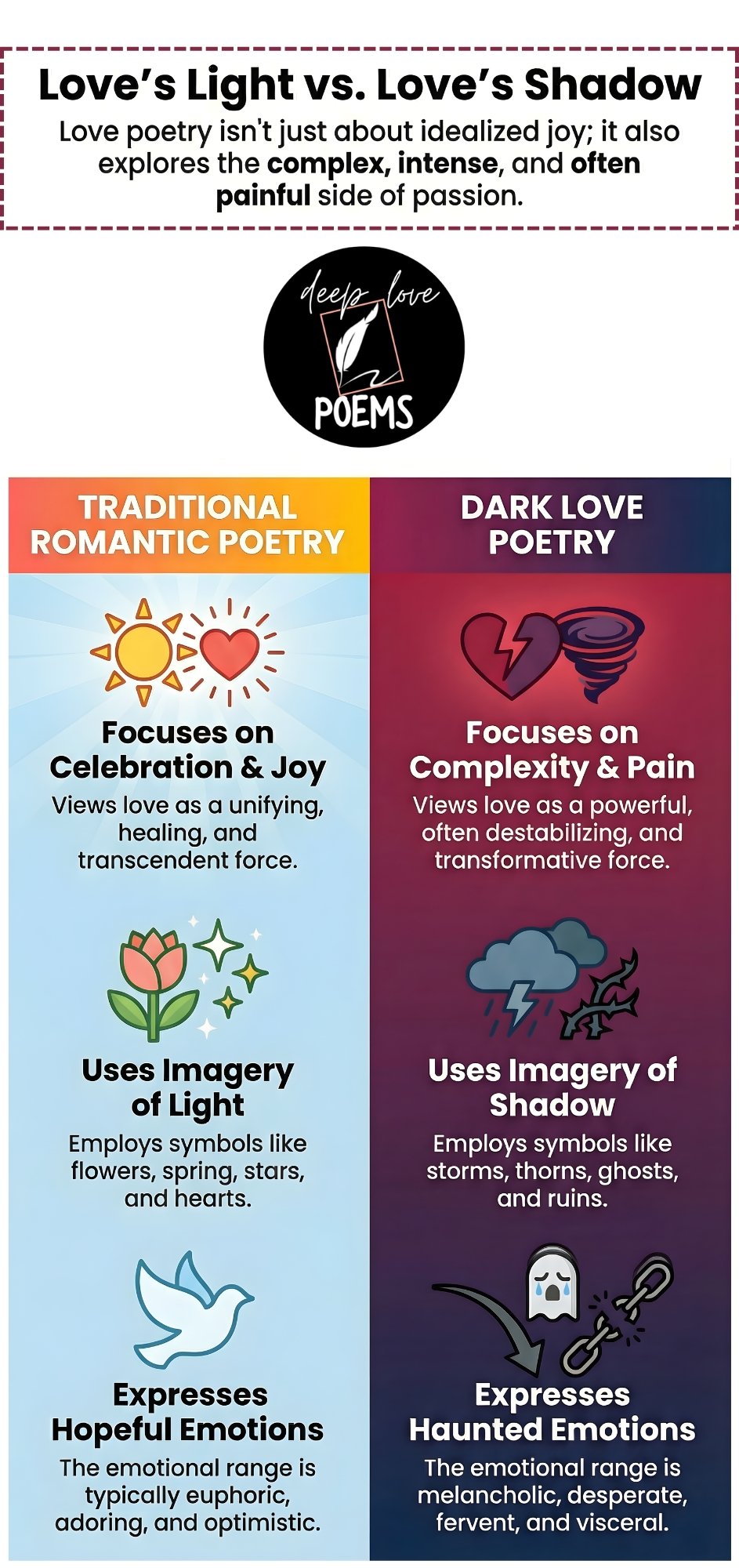
These aren’t decorative choices. They’re honest ones.
My love is not a sun-drenched field of gold, But a tangled wood where ancient stories hide. It’s the phantom touch your memory still holds, And the silent scream of passion, turned to tide. It’s the beauty of the wreckage, stark and true, A midnight bloom, perfumed with deepest blue.
A History Written in Shadow
Dark love poetry is not a modern invention. It runs through the oldest literature we have — the tragic passions of Greek myth, the longing in ancient Chinese verse, the ache threaded through medieval courtly poetry.
But it found its clearest voice in the Gothic and Romantic movements of the 18th and 19th centuries. These were writers who pushed back against the idea that emotion should be controlled, rationalized, or made respectable. They believed the intensity of feeling was itself a form of truth.
Lord Byron became the emblem of this — the brooding, passionate figure whose life and work were inseparable, whose love affairs were catastrophic and legendary in equal measure. His poems don’t just describe longing; they perform it.
Edgar Allan Poe took love further into darkness, into grief, into the question of whether love can survive death — or whether it becomes something stranger and more terrible when the beloved is gone. Annabel Lee is not a sad poem, exactly. It’s something more unsettling than that: a love that refuses to end even when it should.
The tradition carried forward through Sylvia Plath and Anne Sexton, both of whom turned confessional writing toward the most difficult interior landscapes — love, obsession, the complicated relationship between devotion and self-destruction. Their poems made the private unbearably visible.
Contemporary poets like Ocean Vuong and Clementine von Radics carry this forward still, exploring dark love through trauma, identity, and the complexities of queer experience. The genre adapts, but the impulse remains the same: to tell the truth about love, even when — especially when — the truth is difficult.
The Themes That Recur
Certain emotional territories appear again and again in dark love poetry, not because poets lack imagination, but because these experiences are genuinely universal:
Unrequited and forbidden love — the particular anguish of loving someone you cannot have, and the way that love doesn’t diminish just because it’s impossible.
Love and loss — grief as a form of love continuing. The poems that ask whether connection survives death, or whether the dead remain with us in ways we don’t fully understand.
Obsession — the blurred line between deep devotion and something more consuming. The discomfort of recognizing that love and obsession can feel, from the inside, remarkably similar.
Betrayal — not just the sadness of it, but the identity-shifting quality. How betrayal makes you question not just the other person, but everything you thought you knew about yourself.
Melancholic longing — the love for something that cannot be recovered. A person, a time, a version of yourself that no longer exists.
Why We Are Drawn to These Poems
There is something that might seem counterintuitive about seeking out poems that explore pain, obsession, and loss. Why would anyone choose that?
The answer is that dark love poems offer something most curated positivity cannot: recognition.
When a poem articulates something you’ve felt but never been able to say — a jealousy you were ashamed of, a grief that felt excessive, a love that was complicated and inconvenient and real — the effect is not depressing. It’s relieving. It says: this feeling exists. Others have felt it. You are not alone in it, and you are not wrong for having it.
That recognition is, in its way, a form of light.
There is also the matter of catharsis — the old idea that experiencing difficult emotions through art allows us to process them safely, at a remove. Reading about devastating love is not the same as living through it. But it can help us understand what we’ve lived through, or prepare us, in some small way, for what love might ask of us.
Writing in the Dark
If you feel drawn to write this kind of poetry, the starting point is the same as it is for any honest writing: begin with something true.
Not dark for the sake of dark. Not borrowed melancholy. Something real — a specific memory, a feeling you’ve carried too long, an emotion you’ve never found the right words for.
Find your central image. What does this feeling look like? Not metaphorically at first — literally. Is it a room with the door locked? A light left on in an empty house? An unanswered call? Start there, and let the poem build around that image.
Use concrete, physical language. The difference between a dark love poem that moves and one that doesn’t is usually specificity. Not “grief” but the weight of it in the chest. Not “longing” but the way you reach for your phone without thinking and then remember.
Don’t resolve what doesn’t resolve. Dark love poems often resist tidy endings because the emotions they explore don’t have tidy endings. Let the poem end honestly, even if that means it ends in uncertainty.
Reading These Poems Well
The best way to enter a dark love poem is to let it work on you before you try to analyze it. Read it aloud — the rhythm and sound carry meaning that silent reading misses. Notice what tightens in your chest, what image stays with you after you’ve finished.
Then, if you want to go deeper: ask why. Why this word and not another? Why this image? Why does the poem break the line here, pause here, end here? Every choice in a good poem is intentional. Finding those intentions is part of how you come to understand not just the poem but your own response to it.
Where to start if you’re new to the genre: Poe’s Annabel Lee, Plath’s Mad Girl’s Love Song, Shakespeare’s Sonnet 147. Let yourself feel them before you try to understand them.
What These Poems Are, Finally
Dark love poems are not monuments to despair. They are not endorsements of toxic relationships or invitations to wallow.
They are records of what love actually feels like — not the idealized version, but the full version, with all its shadows intact. They are acts of honesty in a world that often prefers the comfortable version of things.
And they offer something quietly radical: the idea that your complicated feelings about love — the ones that don’t fit neatly into happiness or heartbreak — are worth articulating. Worth honoring. Worth turning into something beautiful.
The love that haunts is still love. The poems that ache are still poems. And you — feeling all of it — are still worthy of the words.
 Explore more image-inspired and heartfelt love poems on deeplovepoems.com
and let your heart travel through every verse.