Couples Love: The Power of a Bond That Lasts
Couples Love: The Daily Practice of Choosing Each Other
There’s a version of love that everyone talks about — the falling, the fireworks, the moment you knew.
And then there’s the version that actually sustains a relationship. The one that shows up on an unremarkable Wednesday. The one that knows how to apologize. The one that still reaches for your hand in the middle of an argument, not because the argument is over, but because it remembers that you’re on the same side.
That second kind of love is harder to write poems about. But it’s worth more.
What Couples Love Actually Means
The word “love” in the context of a long relationship carries more weight than it does in the early weeks. It has accumulated. It’s been tested. It knows things about you that the early version didn’t.
At its most durable, couples love holds three things together at once:
The emotional — the safety to be known without performance, to be tired or frightened or uncertain and still feel held.
The psychological — the sense that you are building something together, that the story you’re writing has two authors and that both of them are committed to the ending.
The physical — not just desire, though that too, but the smaller things: a hand on the shoulder when passing through a room, the particular comfort of sleeping next to someone who knows you.
When these three are tended — not perfectly, but consistently — love becomes something more than feeling. It becomes a place.
Your voice is the porch light of my heart,
I find my way home by the warmth.
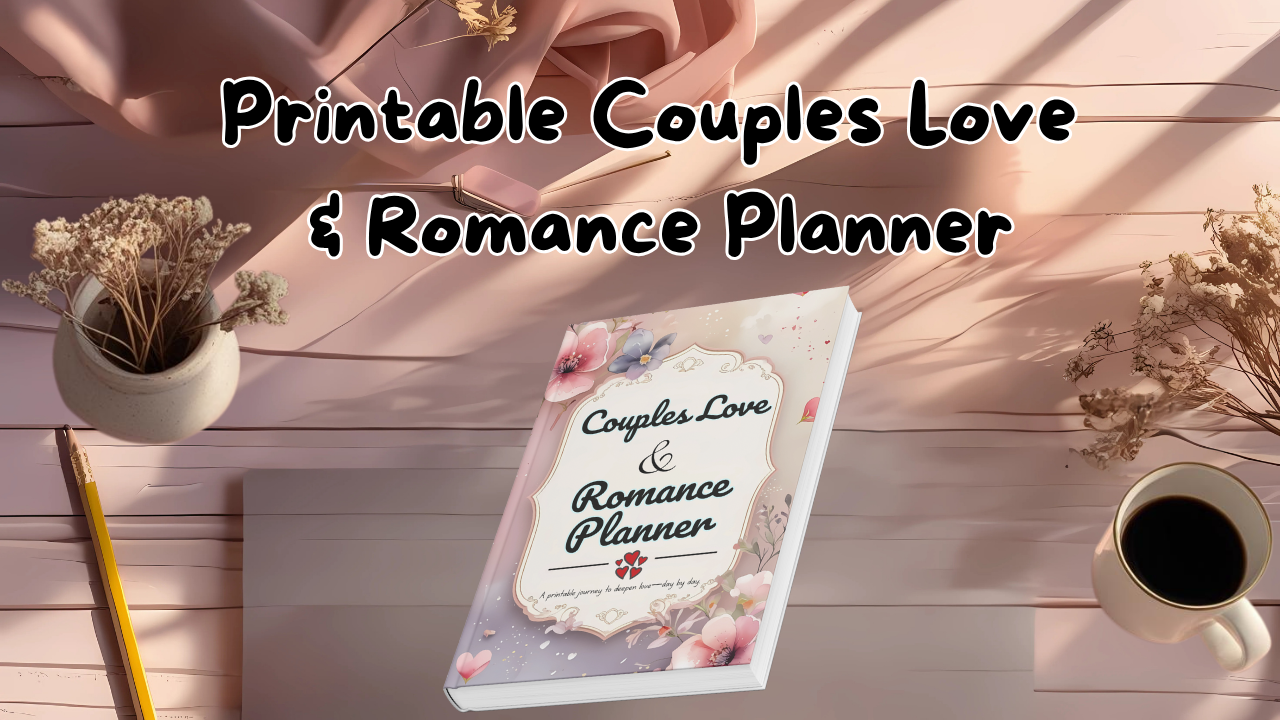
💞 Turn Silence Into Connection – 114 Guided Pages to Bring Back the Spark!
The Stages, Honestly
The early stage of love is well-documented — the intensity, the idealization, the sense that this person is extraordinary in ways no one else could fully appreciate. It’s real. It’s also not the whole story.
What follows is slower and, in its own way, more interesting. The deepening that happens when you’ve seen each other under pressure. When you’ve disagreed badly and come back anyway. When ordinary mornings have accumulated into something that feels like home.
The third stage — commitment, chosen repeatedly — is the one most love poetry ignores. It doesn’t photograph as easily. But it’s where the actual depth lives.
Falling was a beginning;
choosing is our every day.
On Communication
Most relationship advice about communication is correct and largely useless because it describes what to do without acknowledging how hard it is to do it when you’re frustrated or hurt or tired.
What actually works tends to be simpler than the frameworks suggest:
Slow down before you speak. The first version of what you want to say in a difficult moment is rarely the truest version.
Speak from your own experience rather than diagnosing theirs. There’s a significant difference between I felt hurt when and you always.
Learn to make repair attempts — the small gestures that say I know we’re in the middle of something hard, and I still want to be close to you. A hand extended. A soft joke that doesn’t minimize. A genuine apology without conditions attached.
And when things have settled, come back to the conversation. The willingness to return — not to win, but to understand — is one of the clearest signs that love is still choosing to work.
In the middle of our hardest words,
your hand was the sentence that saved us.
The Small Things That Keep Love Close
Grand gestures matter less than frequency. A relationship is made of accumulated small moments — and small moments can be tended.
A one-line gratitude. Not every day necessarily, but often. Something specific: not I love you (though that too) but I noticed what you did this morning and it mattered. Specificity is intimacy.
A shared ritual. Weekly, if possible — something that belongs just to the two of you. It doesn’t need to be elaborate. The same coffee order picked up on Friday mornings. A walk that’s become yours. The accumulation of ordinary repeated things is how love makes itself visible over time.
Poetry, or something like it. A short poem sent before she sleeps. A few lines written in a card that she’ll find later. Not because you are a poet, but because taking the time to find the right words for someone is itself an act of love.
I love the ordinary you touch —
even the keys sound happier
when you come home.
Writing a Love Poem When You’re Not a Poet
The most common mistake people make when writing love poems is trying to sound like a poet. The result is language that’s elevated but impersonal — beautiful in a generic way, recognizable to no one.
The better approach is to start with something true and specific. Not your beauty is like the sun but the actual thing — the sweater she always wears when it rains, the way he laughs before he gets to the punchline, the particular quality of a Saturday morning in your home together.
Start there. Then ask: what does this make me feel? And then: how do I want them to feel when they read this?
You don’t need a structure. You don’t need to rhyme. You need honesty and a single image that belongs to the two of you.
A simple template if you need somewhere to begin:
I love the way you ________ when ________;
how ________ makes the room gentler.
Keep my hand, and I’ll ________ every day.
Fill it in with something real. That’s already a poem.
Six Short Poems to Send Today
These are ready to use as they are, or change a detail to make them yours.
Your patience is my safe place;
your laugh, the window I open first.
We learned the weather together,
and the sun kept finding us anyway.
You hand me the softer word,
and the whole evening listens.
Ordinary coffee, extraordinary you —
even the mug remembers our mornings.
I forget my hurry next to you;
time sits down and stays awhile.
Let’s be the promise we keep repeating —
quiet, steady, bright.
What Sustains a Bond Over Time
Trust is built in the small moments of follow-through, not in the declarations. Showing up when you said you would. Keeping what was told to you in confidence. Being consistent enough that your partner doesn’t have to guess who you’ll be today.
Respect is quieter than trust but just as load-bearing. It’s the choice to honor how your partner sees the world even when you see it differently. To keep their dignity intact in arguments. To remember that their dreams matter even when they’re inconvenient.
Repair is perhaps the most underrated of the three. Every relationship breaks, in small ways and occasionally in larger ones. The question is never whether rupture will happen but whether you’ll turn toward each other afterward. The willingness to repair — to say I was wrong or I want to understand or simply I’m still here — is what keeps a bond from becoming brittle.
We keep getting lost,
then draw better maps.
On Choosing, Again
The romantic version of love is a feeling that happens to you. The real version is a choice you make repeatedly, on ordinary days, under ordinary circumstances, without applause.
It’s choosing to be curious about this person instead of certain. Choosing to speak carefully instead of just honestly. Choosing to stay in the conversation when leaving would be easier.
That choosing — patient, unspectacular, daily — is where the depth lives. And it is worth writing poems about.
Page by page, we edit our storms,
and underline every sunrise we survive.
YOU MAY ALSO LIKE
Love After Love Poem
love poem inspired by photo
10 Good Night Love Poem For Her
Whisper Beneath the Lights